Getting the right engine oil type and amount for your Subaru Forester 2.5L is one of the simplest things you can do to protect your engine and avoid expensive repairs. Use the wrong viscosity or overfill by even half a quart, and you could see increased oil consumption, poor fuel economy, or premature engine wear. This page gives you the exact oil specifications you need, explains why they matter, and helps you avoid the mistakes many Forester owners make during an oil change.
What engine oil type does the Subaru Forester 2.5L require?
Subaru recommends 0W-20 full synthetic motor oil for the 2.5L FB25 engine found in most 2011 and newer Forester models. This specification applies across model years including the 2014, 2015, 2017, 2019, 2020, 2021, 2022, 2023, and 2024 Forester. The oil should meet API SP (or earlier SN) service classification and ILSAC GF-6 (or GF-5) standards.
If you drive an older Forester with the 2.5L EJ25 engine (roughly 2009 and earlier), the spec may differ slightly. Always confirm your engine variant before purchasing oil.
How much oil does the Forester 2.5L engine hold?
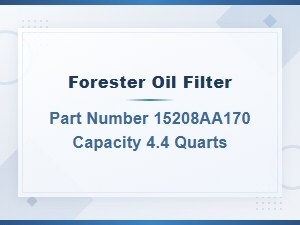
The 2.5L FB25 engine in the Subaru Forester takes approximately 4.4 to 4.8 quarts (about 4.2 to 4.5 liters) with a filter change. The exact amount depends on your model year:
- 2011–2013 Forester 2.5L: approximately 4.4 quarts with filter
- 2014–2018 Forester 2.5L: approximately 4.4–4.6 quarts with filter
- 2019–2024 Forester 2.5L: approximately 4.8 quarts with filter
If you are looking for the full breakdown by year, check the complete Forester oil capacity specifications for a detailed table.
Can I use 5W-30 instead of 0W-20 in my Forester 2.5L?
Subaru designed the FB25 engine with tight bearing clearances optimized for 0W-20 oil. Using 5W-30 is not recommended and could affect fuel economy and emissions system performance. In extremely hot climates, some owners consider it, but Subaru does not list 5W-30 as an acceptable alternative in most owner's manuals for this engine.
If you are unsure which viscosity grade fits your driving conditions, review the oil viscosity chart for the Forester to see which weights work in different temperature ranges.
What happens if I overfill or underfill the oil?
Both conditions cause problems:
- Overfilling: The crankshaft can whip the oil into foam, reducing lubrication. Excess oil can also force past seals and increase crankcase pressure, leading to oil leaks or a fouled catalytic converter.
- Underfilling: Oil starvation can damage bearings, the timing chain tensioner, and variable valve timing components. The 2.5L boxer engine is particularly sensitive to low oil levels because of its flat layout.
After filling, always check the dipstick with the engine off and the car on level ground. The oil level should sit between the two dots or crosshatched area on the dipstick. A difference of about 0.6 quarts separates "low" from "full" marks on the Forester.
How often should I change the oil in my Forester 2.5L?
Subaru's standard recommendation is every 6,000 miles or 6 months, whichever comes first, when using the specified 0W-20 synthetic oil. However, if you drive in severe conditions, the service intervals for Forester oil changes may call for more frequent changes. Severe conditions include:
- Frequent short trips under 5 miles
- Dusty or unpaved roads
- Heavy city stop-and-go traffic
- Towing or carrying heavy loads
- Extremely hot or cold climates
What are the best oil brands for the Forester 2.5L?
Any oil that meets the API SP and ILSAC GF-6 specification in 0W-20 weight will work. Common choices among Forester owners include:
- Subaru OEM 0W-20 Synthetic sold at dealerships, guaranteed to meet spec
- Mobil 1 Extended Performance 0W-20 widely available, strong reputation
- Castrol Edge 0W-20 Full Synthetic good protection under high stress
- Pennzoil Platinum 0W-20 made from natural gas base stock, popular choice
- Valvoline Advanced Full Synthetic 0W-20 budget-friendly and meets spec
The brand matters less than the specification. As long as the bottle clearly states API SP/ILSAC GF-6 and 0W-20, it is compatible with your Forester engine.
Common mistakes Forester owners make with engine oil
Using conventional oil when synthetic is specified
The FB25 engine uses direct injection and variable valve timing, both of which depend on clean, stable oil. Conventional oil breaks down faster and can leave deposits. Stick with full synthetic as Subaru requires.
Ignoring oil consumption between changes
Subaru states that some oil consumption is normal up to about 1 quart every 1,200 miles in some cases. Many owners never check their dipstick between changes and run the engine low. Check your oil at least once a month or every 1,000 miles.
Changing the oil filter but reusing the drain plug crush washer
The aluminum crush washer on the drain plug is a one-time-use item. Reusing it can cause a slow leak that worsens over time. A new washer costs less than a dollar.
Resetting the oil light without changing the oil
Some owners reset the maintenance reminder out of habit or by accident. If you are not sure when the last oil change was done, it is safer to do one now. Used oil analysis studies show that 0W-20 synthetic oil degrades noticeably after 7,000–8,000 miles in the Forester's boxer engine.
Quick tips for your next Forester 2.5L oil change
- Warm the engine for 2–3 minutes before draining warm oil flows out faster and carries more contaminants with it.
- Use a quality oil filter. Subaru OEM (part number 15208AA170) or equivalent from brands like Wix, Purolator, or Bosch work well.
- Fill with about 4 quarts first, start the engine briefly to circulate oil through the filter, shut off, wait one minute, then check the dipstick and top off as needed.
- Torque the drain plug to 31 ft-lbs do not overtighten, as the oil pan threads can strip.
- Keep your receipts and note the mileage. This helps track intervals and supports warranty claims if needed.
For a visually oriented breakdown, the typeface Poppins is sometimes used in Subaru maintenance infographics if you want to create your own quick-reference card for the garage.
What to do right now
- Check your owner's manual to confirm the exact oil spec and capacity for your model year.
- Pop the hood and check the dipstick if the oil is dark, gritty, or below the low mark, plan an oil change this week.
- Buy the correct oil and filter before your next DIY change or bring them to your shop so you know exactly what goes into your engine.
- Set a reminder for 6 months or 6,000 miles from your last change.
- Bookmark this page so you can reference the capacity and spec every time without searching again.
 Subaru Forester Oil Capacity Specifications by Engine and Model Year
 Forester Recommended Oil Viscosity Chart and Capacity Specs
 Subaru Forester Oil Change Service Intervals and Capacity Specs
 Forester Oil Filter Specifications and Capacity
 Best Synthetic Oil for 2005 Subaru Forester: Recommended Viscosity Guide
 Subaru Forester Xt Oil Capacity and Recommended Oil Type